 CASTLE
The reconstruction shows the Hospitaller “acropolis” of Caspe in 1412, when the castle hosted the Compromise that gave the Crown of Aragon to the Trastámara dynasty: a compact Gothic palace on the cliff, with the Hall of the Compromise and the keep facing the collegiate church of Santa María. Today the castle overlooks the Mequinenza reservoir; in 1412 the Ebro ran in its own bed, a few kilometers to the north, but the terrain data only record the water surface, so that valley cannot be reconstructed.
Works in the browser on computers and phones, with nothing to install. Fly with the drone and switch between then and now.
Interpretive recreation: our approach ›
Or fly over it as the centuries go by: from the first settlement to today, with the town growing and the milestones of its history.
Or watch how it was raised: the years of building up to its heyday, with masons, treadwheel cranes, carts and the passing seasons (interpretive recreation).
🏰 Enter the castle in 3D⏳ See how it changed⚒ How they built it
- Period reconstructed
- c. 1412
- Town
- Caspe
- County
- Bajo Aragón-Caspe
- Province
- Zaragoza
- Region
- Aragon
- Coordinates
- 41.23641, -0.03687 · Open the map
Leave us your email and we'll send you the poster of this castle at its height, high resolution, ready to print, plus two wallpapers (computer and phone). We'll also tell you about news on this castle. No passwords; unsubscribe any time.
Are you at the castle? Get its stamp for your castle passport. We only check that you are within 300 m; we don't store your location.
Hall of the Compromise
A great Gothic hall on the west façade, with three tracery windows; the arbiters met there in 1412. Today it is a terrace.
Collegiate church of Santa María
A Gothic church with three naves, collegiate since 1394; Ferdinand I was proclaimed king in it in 1412.
Keep
A square, crenellated tower next to the hall, with the main Gothic doorway; it disappeared after 1871.
Parade ground
An open space between the east end of the church and the west façade of the castle.
East front
A battered wall above the Guadalope cliff, with large buttresses.
Cylindrical tower
A rubble-masonry tower at the southern end, with a lintel bearing crosses of the Order.
North block
A trapezoidal block with the antechamber and a twin-light window.
Convent of San Juan
A convent of the Order founded in 1394 by Heredia, south of the castle; demolished around 1830.
La Muela quarter
The original core of Caspe, where Jews were already living in 1169.
Miralpeix Mausoleum
A Roman mausoleum from the 2nd–3rd c., moved in 1962 from the bank of the Ebro to save it from the reservoir.
The river and the reservoir
In 1412 the valley of the Guadalope lay here and, further north, the Ebro; since 1966 it has all been under the Mequinenza reservoir.
Videos and stories about this place on our account.
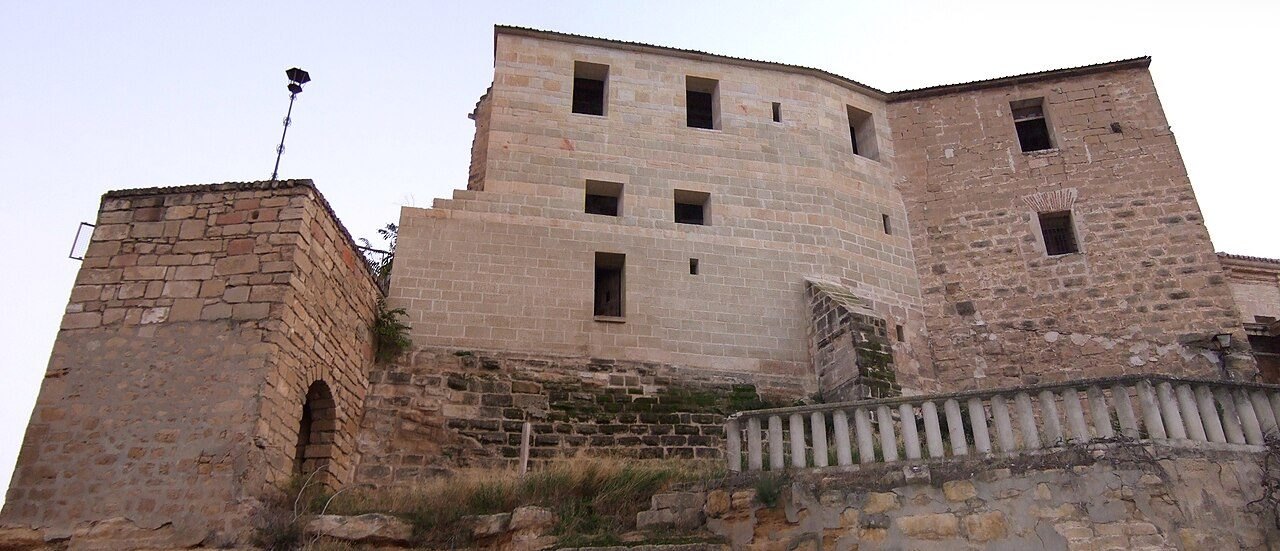
Photo: ecelan (talk) · CC BY 2.5
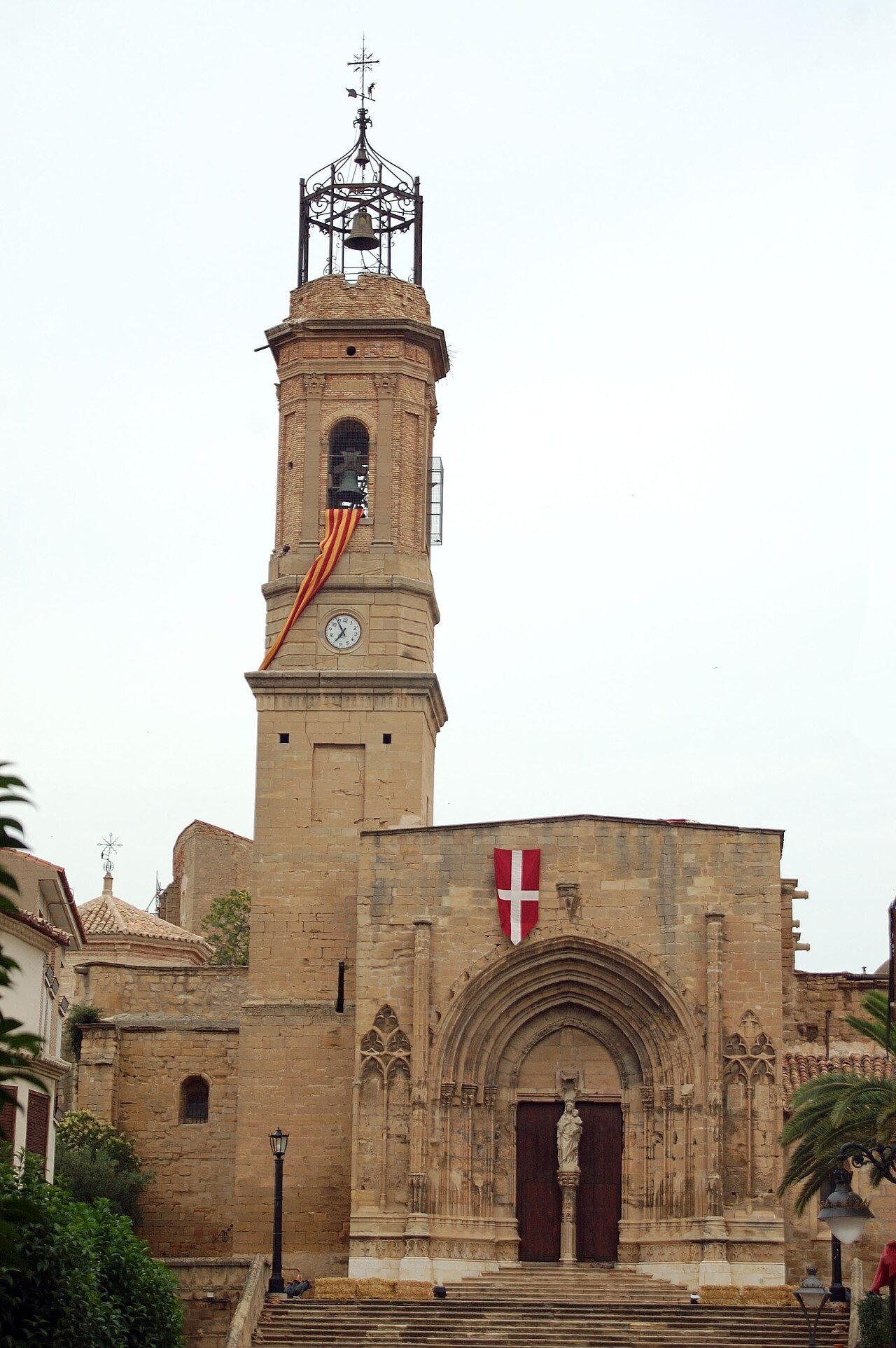
Photo: Javier Giménez · CC BY-SA 3.0
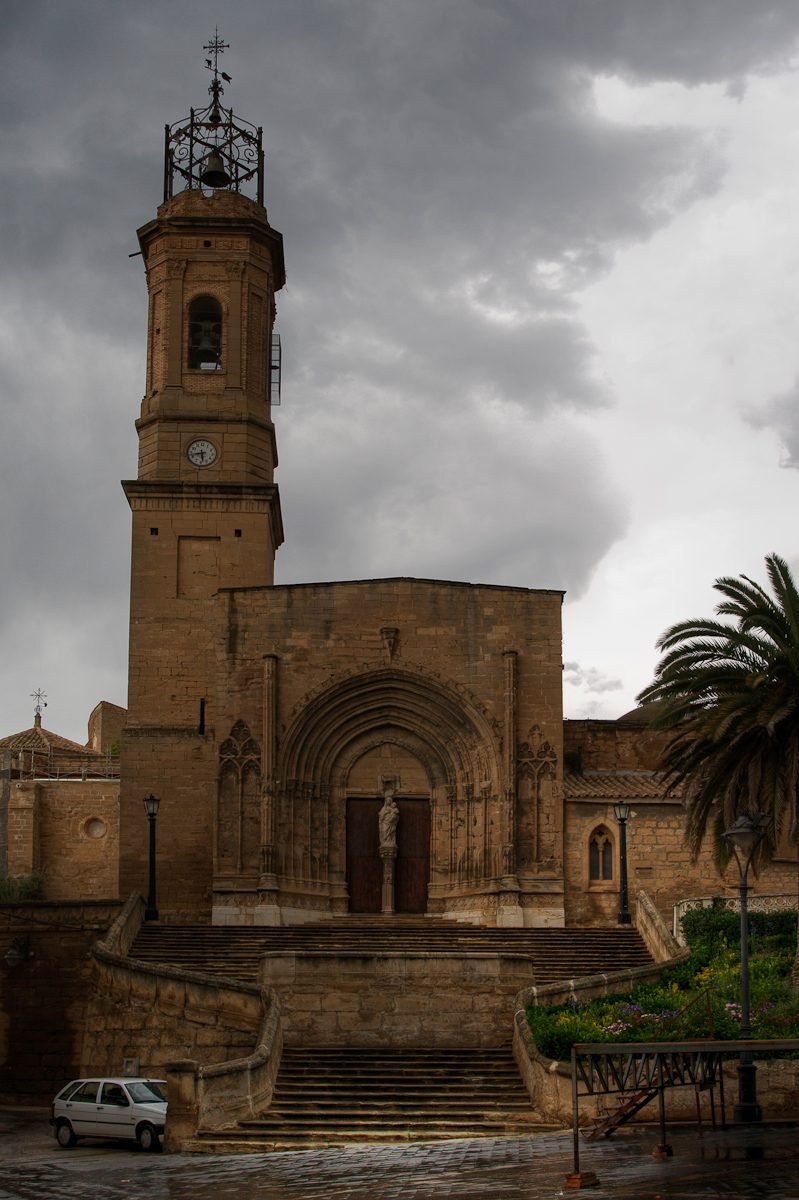
Photo: Javier G. R. · CC BY-SA 3.0
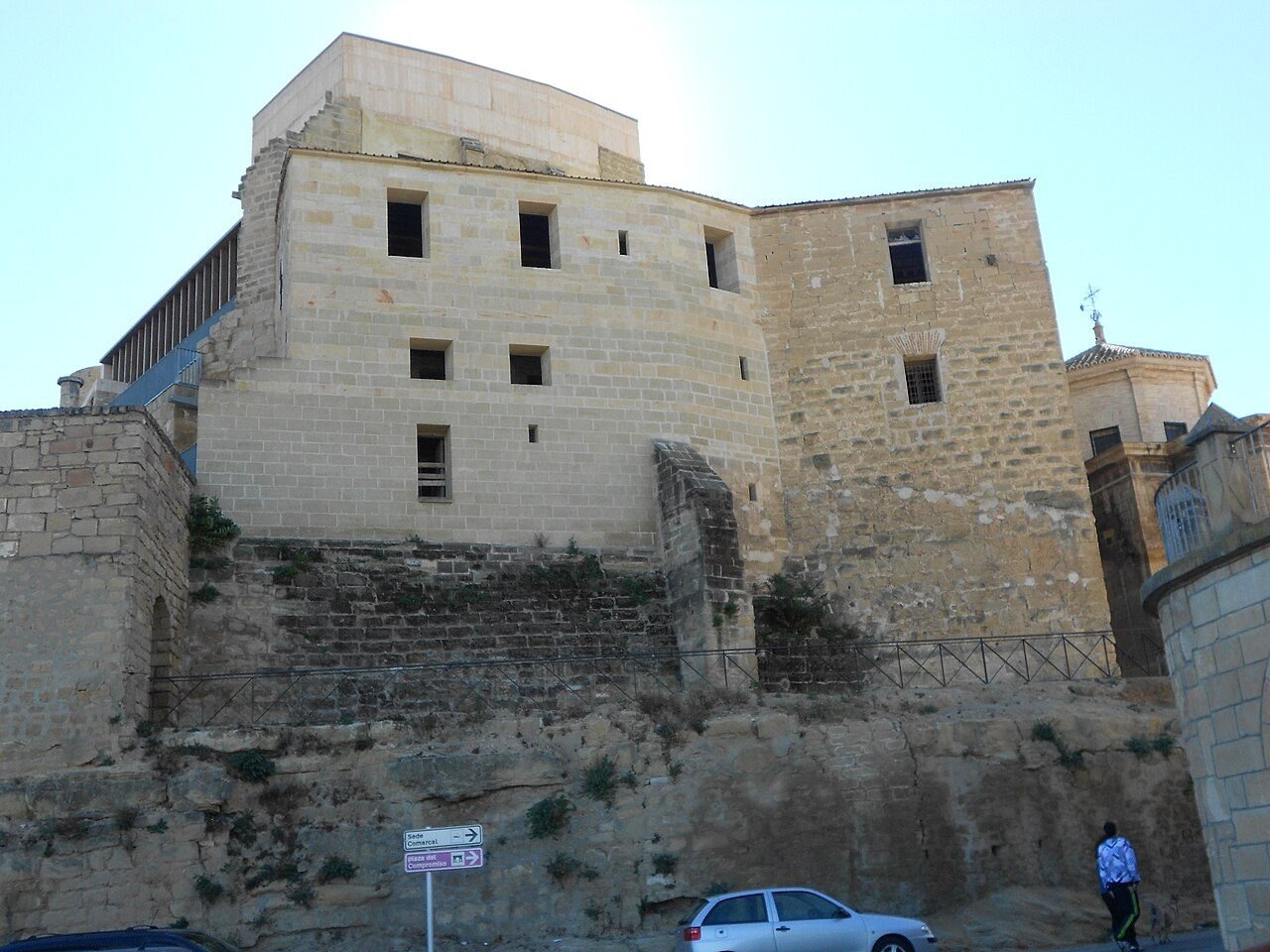
Photo: Fran Ara · CC BY-SA 3.0
- 7th c. BC – 3rd c. AD
Iberians and Romans
The area was inhabited by Iberians; from the Roman period the Miralpeix mausoleum survives, moved in 1962 to save it from the reservoir.
source: Wikipedia: Caspe - 713–1169
Andalusi Qasb
Caspe is part of the Upper March of al-Andalus; tradition places the castle on top of an old Muslim palace.
source: Ayuntamiento de Caspe: catálogo de patrimonio cultural - 1169
Christian conquest
Alfonso II incorporates Caspe into the Crown of Aragon in a swift campaign through the Bajo Aragón.
source: Wikipedia: Caspe - 1182
Grant to the Order of the Hospital
Alfonso II grants the town and the castle to the Hospitallers; the castle becomes the residence of the order's bailiff.
source: Ayuntamiento de Caspe: catálogo de patrimonio cultural - 14th c.
Gothic fortified palace
The castle is rebuilt in Gothic style as a fortified palace of 55 × 27 m, with a great wall toward the river reinforced by buttresses.
source: Castillo del Compromiso de Caspe (TFG, Universidad de Zaragoza, 2016) - 1388–1396
Heredia and the collegiate church
Grand Master Juan Fernández de Heredia makes Santa María a collegiate church (1394), founds a convent and is buried there in 1396.
source: SIPCA: Colegiata de Santa María la Mayor - 1412
Compromise of Caspe
Nine arbiters meet in the castle between March and June. On June 24 Ferdinand of Antequera obtains six votes, and on the 28th Vincent Ferrer proclaims his election in Santa María.
source: Viquipèdia: Compromís de Casp - 1701–1813
First destructions
The War of the Spanish Succession leaves the defenses in ruins; in 1813 the French garrison holds out in the convent and the castle.
source: Castillo del Compromiso de Caspe (TFG, Universidad de Zaragoza, 2016) - 1833–1876
A fort in the Carlist Wars
The castle is turned into a fort; in 1873 the Carlists take it and set it on fire, and the Hall of the Compromise and the keep are lost.
source: Castillo del Compromiso de Caspe (TFG, Universidad de Zaragoza, 2016) - 1884–1891
Prison, plunder and demolitions
The east wing is used as a prison; the door of the Hall of the Compromise is moved to the Town Hall in 1889.
source: Ayuntamiento de Caspe: catálogo de patrimonio cultural - 1936–1939
Civil War
Caspe is the seat of the Council of Aragon; a fire destroys the vaults of the collegiate church and the ruined castle serves as a prison.
source: SIPCA: Colegiata de Santa María la Mayor - 1966
The Mar de Aragón
The Mequinenza dam floods the valley of the Ebro and the Guadalope at the foot of Caspe.
source: Wikipedia: Embalse de Mequinenza - 2004–today
Restoration
Restoration in phases begins in 2004; the castle opens to the public for the sixth centenary of the Compromise (2012).
source: Wikipedia: Castillo del Compromiso
Using the 3D model we worked out how big this castle was and what it took to build it. Here is a sample:
- How many people worked, how much stone, lime and carts, year by year
- Work by work and how we calculate it
- The data to download (CSV)
Leave your email and you will see everything, for this castle and all the others. As a gift, the castle poster.
Already signed up? Sign in with your email🏰 Enter the castle in 3D⏳ See how it changed⚒ How they built it