 CASTLE
The reconstruction shows Lleida around 1430, with the bell tower newly crowned and the cloister complete. At the top of the hill stands the King's Castle or Suda, with four wings around a courtyard, and beside it the Seu Vella, consecrated in 1278. The ground plan of the cathedral, the cloister and the bell tower follows the Cadastre; their volumes are an approximation. The hilltop enclosure, the line of the city wall and the streets are hypothetical: the bastions seen today date from the 17th and 18th centuries and swept away the Suda quarter.
Works in the browser on computers and phones, with nothing to install. Fly with the drone and switch between then and now.
Interpretive recreation: our approach ›
Or fly over it as the centuries go by: from the first settlement to today, with the town growing and the milestones of its history.
🏰 Enter the castle in 3D⏳ See how it changed⚔ The siege of Lleida (1464)
- Period reconstructed
- c. 1430
- Town
- Lleida
- County
- Segrià
- Province
- Lleida
- Region
- Catalonia
- Coordinates
- 41.61770, 0.62630 · Open the map
Leave us your email and we'll send you the poster of this castle at its height, high resolution, ready to print, plus two wallpapers (computer and phone). We'll also tell you about news on this castle. No passwords; unsubscribe any time.
Are you at the castle? Get its stamp for your castle passport. We only check that you are within 300 m; we don't store your location.
La Seu Vella
A cathedral begun in 1203 by Pere de Coma and consecrated in 1278: three naves, a transept, an octagonal lantern tower and five apses. The walls follow the Cadastre; the roofs and heights are approximate.
The cloister
At the west end of the church, which is unusual, with galleries of about 48 × 9 m and five large windows open to the city.
The bell tower
Octagonal and 60 m tall, at the corner of the cloister; Carlí was working on its crown in 1416. The model makes it round: the engine has no octagonal shafts.
Porta dels Fillols
In the south nave, from c. 1220–1240, with a Gothic porch from c. 1386. The model does not show its sculpture.
La Canonja
The canons' quarters next to the cloister, from the 12th to the 16th centuries. The shape is approximate.
The King's Castle or Suda
A castle with four wings around a courtyard with a cistern, a royal residence until Martin the Humane. The published measurements have not been found: the plan comes from the orthophoto and from the Consorci's restitution.
West gate (hypothesis)
The sources place the main gate of the Suda to the west, but the exact line of the hilltop wall has not been found.
Sant Joan de la Plaça
A medieval parish church, demolished in 1868; remains have been found beneath the square. The model shows a generic church.
La Paeria
A house on Carrer Major, seat of the city government since 1383; it is not drawn separately from the other houses.
Portal del Pont
A Gothic gate facing the stone bridge over the Segre. The engine cannot draw the bridge: it is not in the model.
Sant Llorenç
A Romanesque church with three naves and a Gothic tower, still standing. The volume is approximate.
Sant Martí
A single-nave church next to the Sant Martí gate, in the quarter of the Estudi General, founded in 1300.
Portal de Magdalena
The northeastern entrance to the city; in 1707 the Bourbon troops entered through the breach here.
Videos and stories about this place on our account.
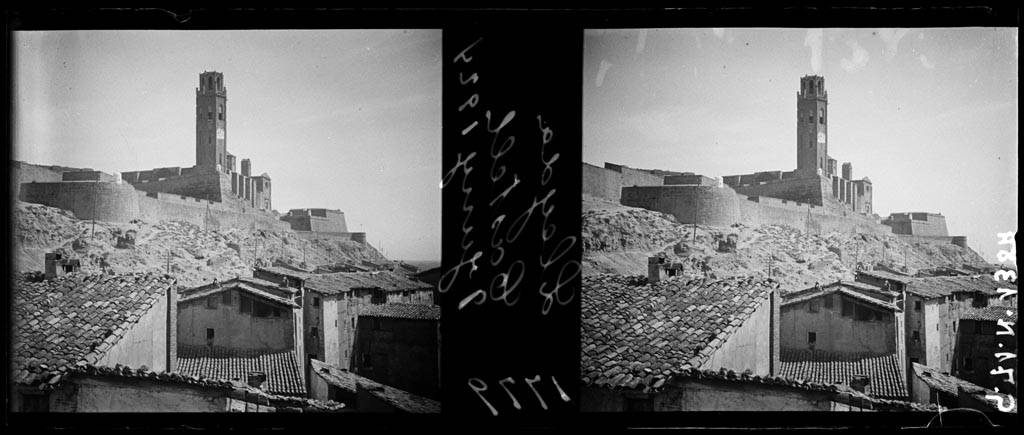
Photo: Jaume Biosca i Juvé · Public domain
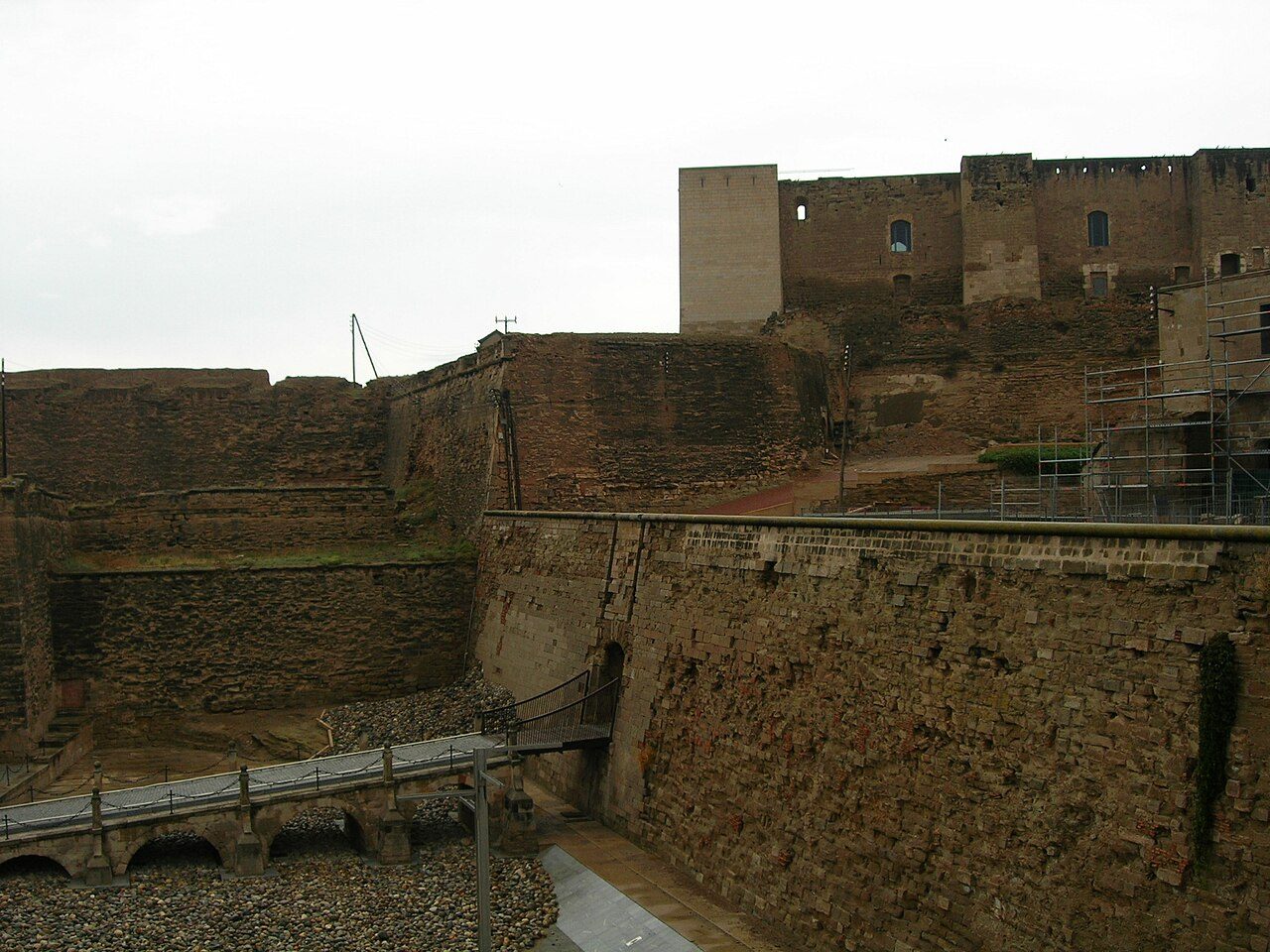
Photo: Enfo · CC BY-SA 3.0
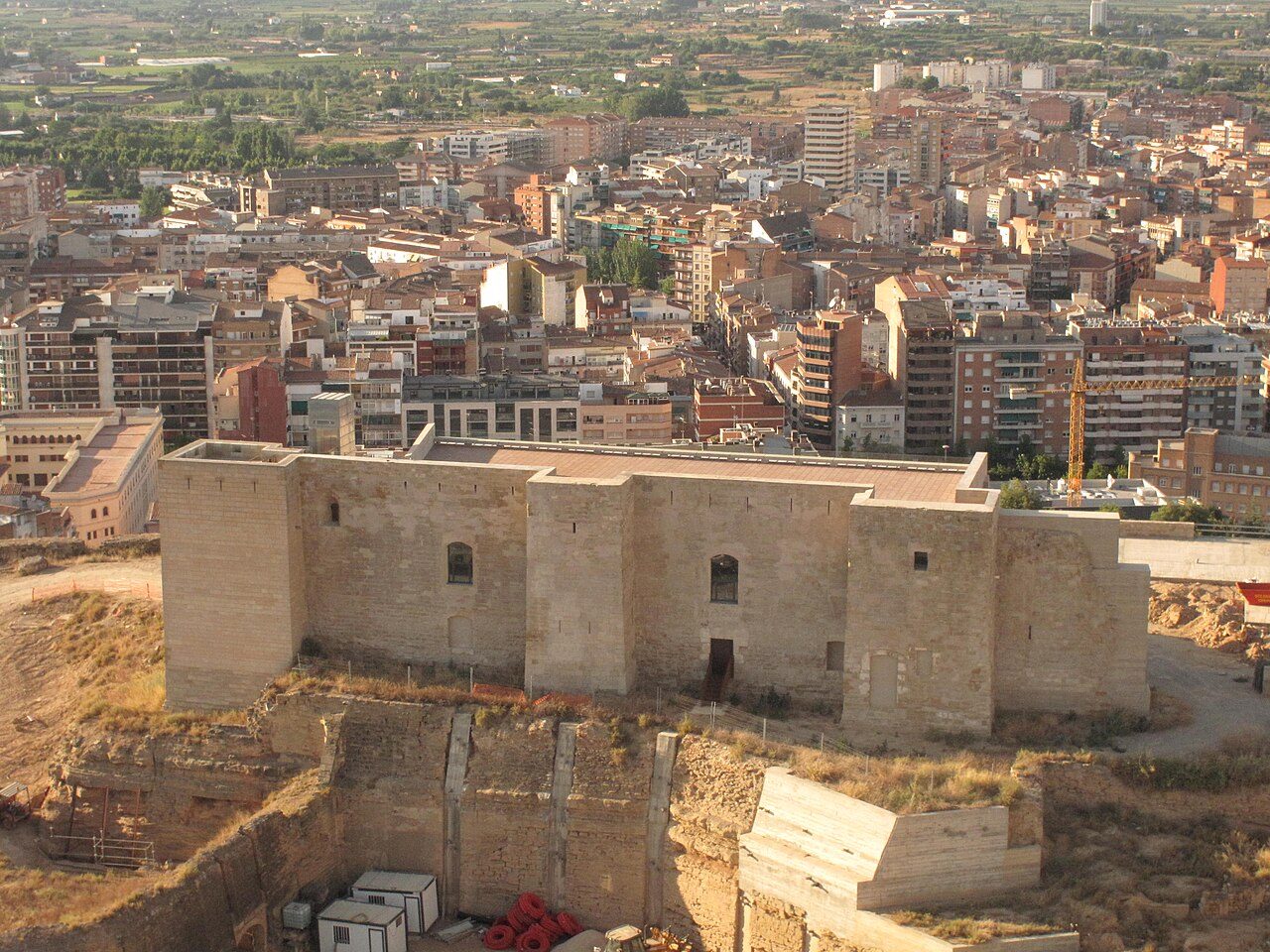
Photo: Enfo · CC BY-SA 3.0
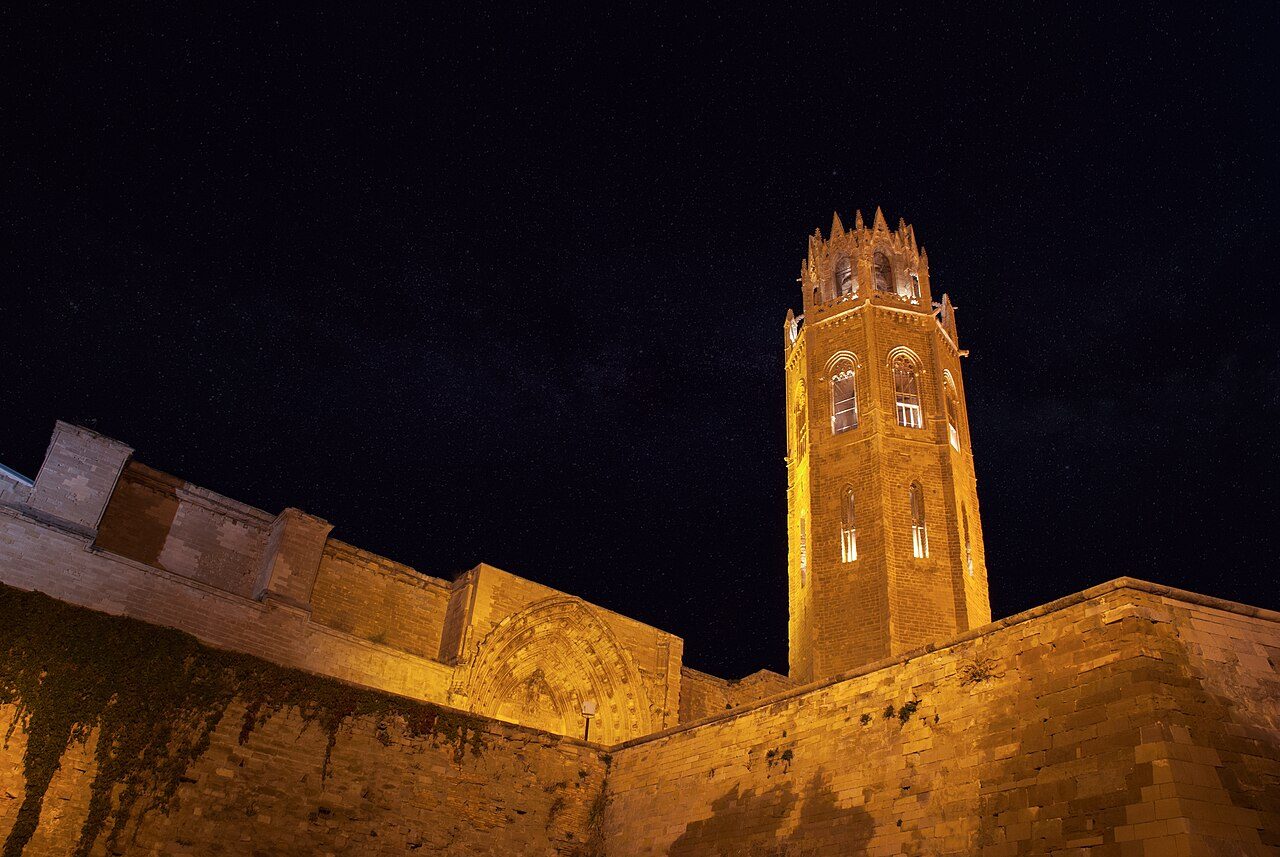
Photo: Nata Mostova · CC BY-SA 4.0
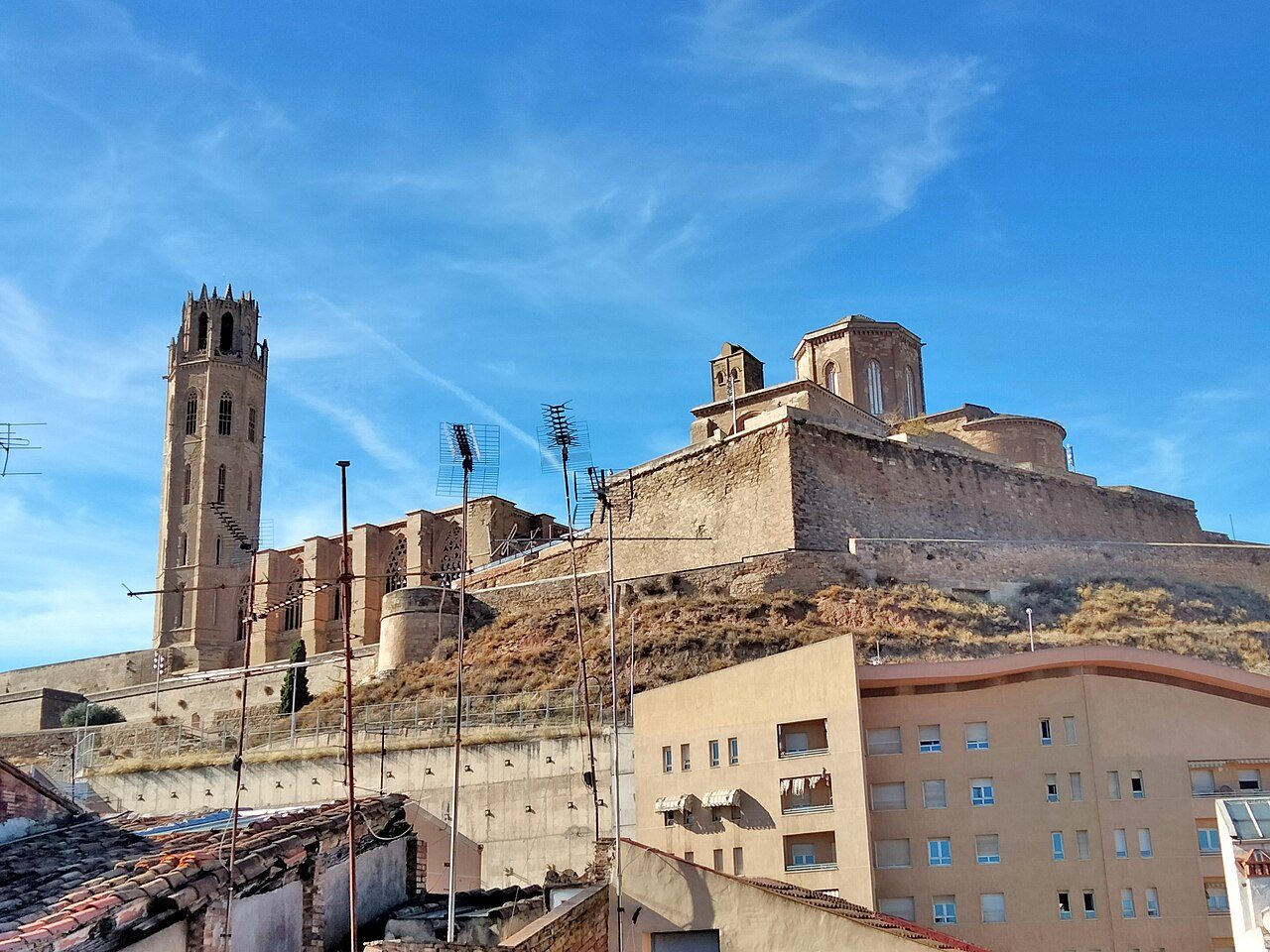
Photo: Enric · CC BY-SA 4.0
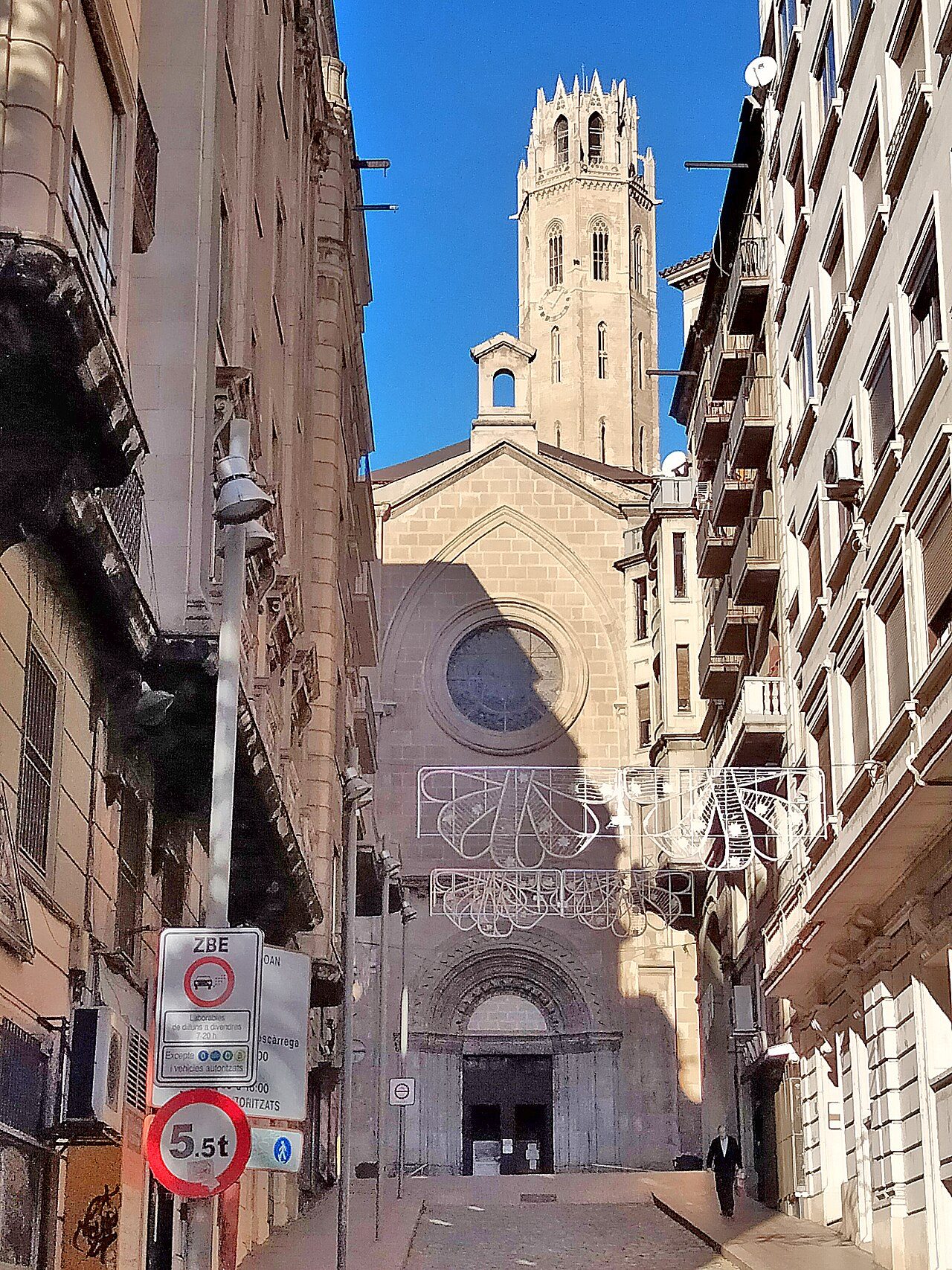
Photo: Enric · CC BY-SA 4.0
- 49 BC
Ilerda
Caesar defeats the Pompeians near the Segre. On the hill a stretch of Roman wall survives next to the Porta del Lleó.
source: Consorci del Turó: muralla romana - 883–884
The Andalusi Suda
Ismail ibn Musa rebuilds the city and fortifies it. The suda dominated the city from the Roca Sobirana, and almost nothing of it still stands.
source: Gran Enciclopèdia Catalana: Lleida - 1149
Conquest
Lleida surrenders on October 24 to Ramon Berenguer IV and Ermengol VI of Urgell. In January 1150 it receives a settlement charter.
source: Catalunya Romànica: Ciutat medieval de Lleida - 1150
Petronila's wedding
Ramon Berenguer IV marries Petronila of Aragon in Lleida, probably in the Suda.
source: Castells Catalans: Castell del Rei de Lleida - 1203–1278
The cathedral
Pere de Coma, hired in 1193, begins the work at the east end. The first stone was laid on July 22, 1203, according to a disputed inscription, and the consecration took place on October 31, 1278.
source: L'Art Gòtic a Catalunya: La Seu Vella de Lleida - 1214
James I recognized
In the Suda, the assembly called by the papal legate recognizes James, a six-year-old boy, as king.
source: Consorci del Turó: les Corts - 14th c.–c. 1430
Cloister and bell tower
The cloister is completed, with 17 large windows and a gallery open to the city, and the 60-meter octagonal bell tower is crowned.
source: Consorci del Turó: el claustre - 1464
Siege by John II
From February to July. The city surrenders after losing more than 400 buildings, stretches of wall and gates.
source: Gran Enciclopèdia Catalana: Lleida - 1641–1649
The citadel
French engineers and later Spanish governors raise the first bastions, and almost the entire Suda quarter disappears. There are sieges in 1644, 1646 and 1647.
source: Consorci del Turó: s. XVII - 1707
Bourbon capture
The city falls on November 2 and the citadel on the 11th. The Seu is closed to worship and the see moves to Sant Llorenç until the new cathedral of 1781.
source: Catalunya Romànica: Santa Maria o la Seu Vella - 1746–1749
Barracks
The order to demolish the cathedral is not carried out, and the engineer Miguel de Marín converts it into barracks by dividing it into floors.
source: Catalunya Romànica: Santa Maria o la Seu Vella - 1812
Powder magazine explosion
On July 15 the Suda's powder magazine explodes: half the castle, the royal chapel and many houses in Magdalena collapse, with more than 500 dead. The Seu loses a small north apse.
source: Gran Enciclopèdia Catalana: Lleida - 1936–1940
War and camp
An explosion blows apart the west wing of the castle in 1936. The city falls on April 3, 1938, and the Seu is a concentration camp until August 1940.
source: Consorci del Turó: camp de concentració - 1948–2011
Restoration
The army leaves the hill in 1948 and the restoration of the Seu begins in 1950. The Castell del Rei opens to the public on March 26, 2011.
source: Catalunya Romànica: Santa Maria o la Seu Vella
- Consorci del Turó de la Seu Vella: El conjunt monumental
- Consorci del Turó: planta de la Seu Vella
- Consorci del Turó: mapa de la fortificació
- Gran Enciclopèdia Catalana: Lleida
- Gran Enciclopèdia Catalana: catedral de Lleida
- Catalunya Romànica: Santa Maria o la Seu Vella
- Catalunya Romànica: Castell del Rei o de la Suda
- Catalunya Romànica: Ciutat medieval de Lleida
- L'Art Gòtic a Catalunya: La Seu Vella de Lleida
- L'Art Gòtic a Catalunya: La ciutat de Lleida
- Patrimoni Gencat: Ruta 1714, Turó de la Seu Vella
- E. Balasch: Lleida, Castell del Rei (IEC)
- MDT: IGN · Ortofoto: ICGC (CC BY 4.0)
- Cadastre (INSPIRE)
🏰 Enter the castle in 3D⏳ See how it changed⚔ The siege of Lleida (1464)