 CASTLE
The reconstruction shows Peñafiel Castle around 1470, once the work of Pedro Girón, Master of Calatrava, was finished: a fortress about 205 m long on an elongated hill, with the 34 m keep in the middle and a curtain wall full of round towers. The layout comes from the Cadastre, the orthophoto and the present remains. Below, the wall of Don Juan Manuel surrounds the town down to the Duratón. The heights of the walls, the buildings in the courtyards, the moat and the houses are hypotheses.
Works in the browser on computers and phones, with nothing to install. Fly with the drone and switch between then and now.
Interpretive recreation: our approach ›
Or fly over it as the centuries go by: from the first settlement to today, with the town growing and the milestones of its history.
Or watch how it was raised: the years of building up to its heyday, with masons, treadwheel cranes, carts and the passing seasons (interpretive recreation).
🏰 Enter the castle in 3D⏳ See how it changed⚒ How they built it
- Period reconstructed
- c. 1470
- Town
- Peñafiel
- County
- Ribera del Duero
- Province
- Valladolid
- Region
- Castile and León
- Coordinates
- 41.59667, -4.11431 · Open the map
Leave us your email and we'll send you the poster of this castle at its height, high resolution, ready to print, plus two wallpapers (computer and phone). We'll also tell you about news on this castle. No passwords; unsubscribe any time.
Are you at the castle? Get its stamp for your castle passport. We only check that you are within 300 m; we don't store your location.
Keep
A 14.5 × 20 m rectangle, 34 m tall, with three vaulted floors and eight turrets. Its walls show three phases: an old base, Girón's work and an extension to the east.
The north «prow»
Tall round tower at the end of the enclosure. The low wall in front of it was dismantled for its stone and rebuilt in the 20th c. The height is estimated from photos.
Main gate
Arch between two round towers, reinforced in 1583 by Juan de Palacios because rainwater was cracking one of the towers.
Gate of the inner enclosure
Entrance next to the moat and the south courtyard. In 1679 it could not be opened and a board was removed from it.
Moat of the tower
In 1679 the tower was entered over a plank laid across the moat. The depth in the model is a hypothesis.
North courtyard
There were cisterns and storehouses here. An older L-shaped wall was found. The buildings against the walls are hypotheses.
South courtyard
It housed the garrison and the horses, and today it is home to the Provincial Wine Museum. Its buildings against the walls are hypotheses.
First wall
By 1679 it had almost entirely collapsed. The outline is that of the present terrace; the medieval shape is a hypothesis.
Town wall
Begun in July 1307, it was about two kilometers long and had five gates and three posterns. Few sections remain; the course of some is uncertain.
Santa María de Mediavilla
Gothic church of the 15th c., today a museum of sacred art. The shape in the model is generic.
Convent of San Pablo
Built on the alcázar of Alfonso X and given to the Dominicans. It is not modeled.
Plaza del Coso
Medieval square with bullfighting festivities documented since 1433. The wooden galleries are later.
Videos and stories about this place on our account.
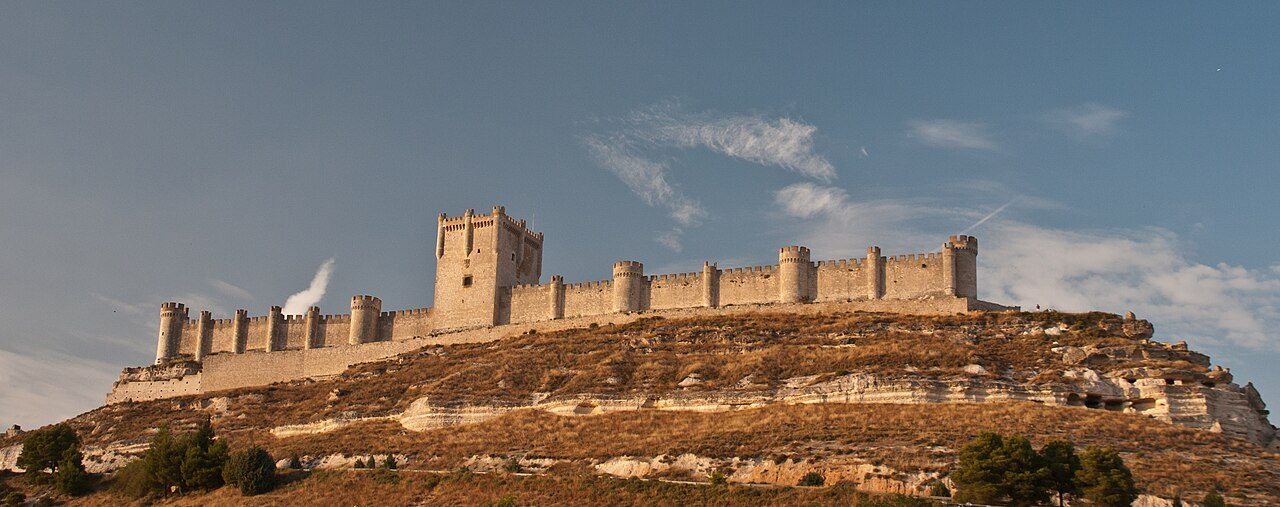
Photo: Ignasilm · CC BY-SA 3.0 es
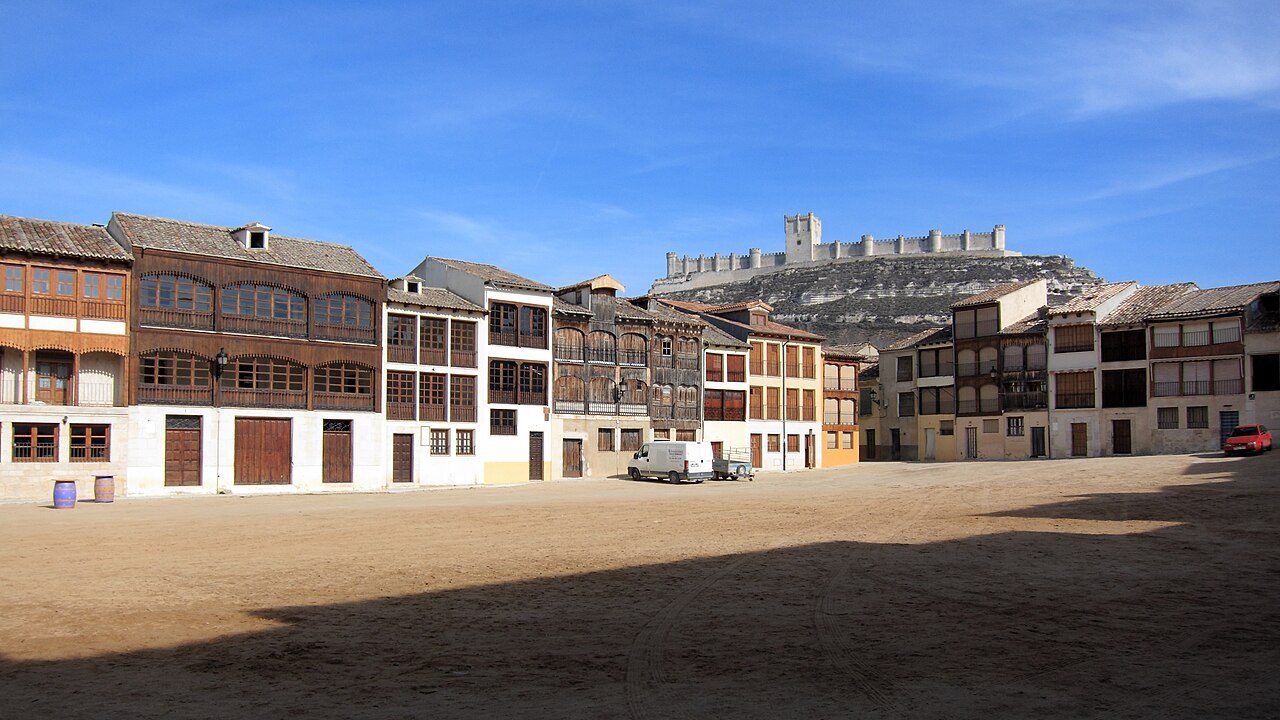
Photo: Barcex · CC BY-SA 3.0
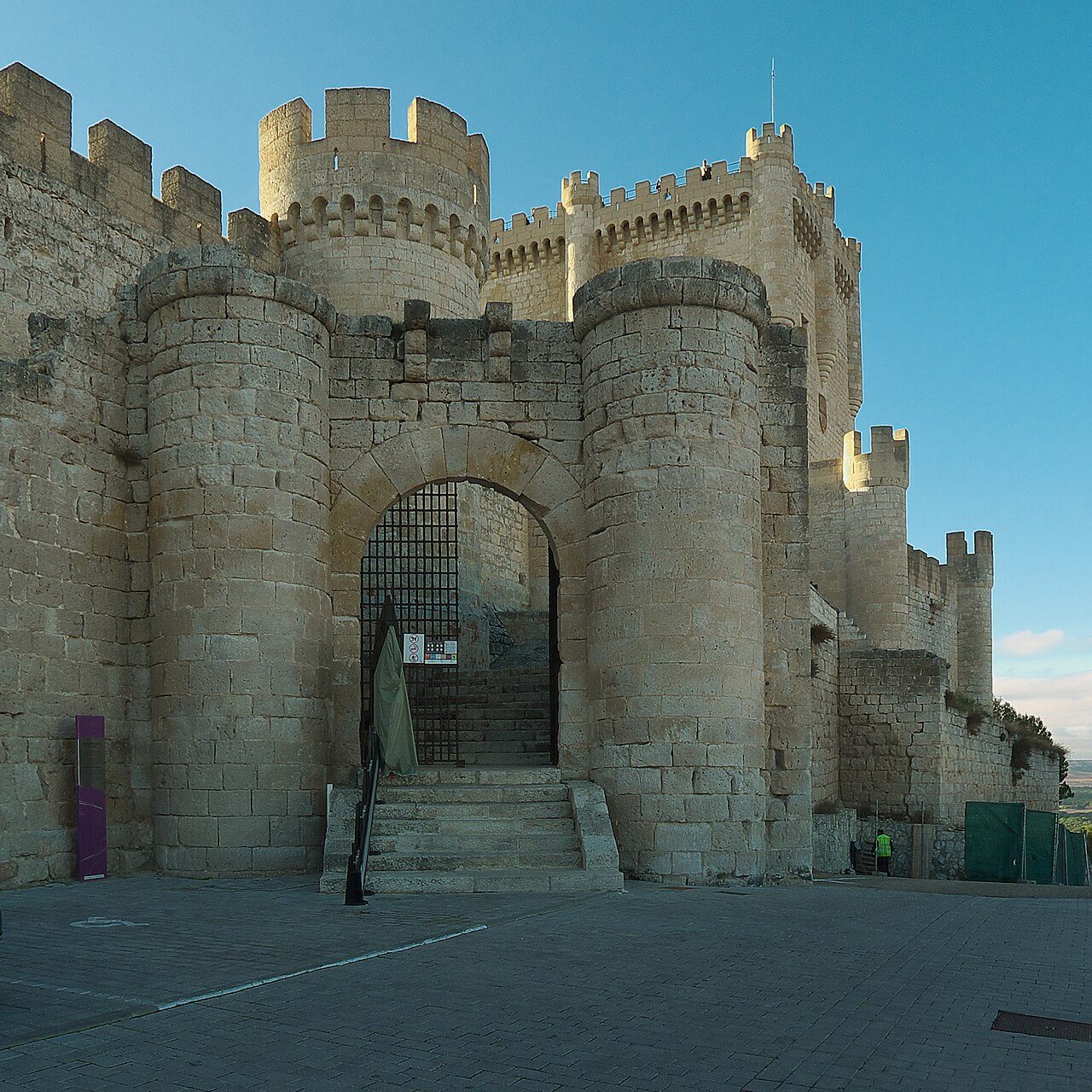
Photo: Jose Luis Filpo Cabana · CC BY 3.0
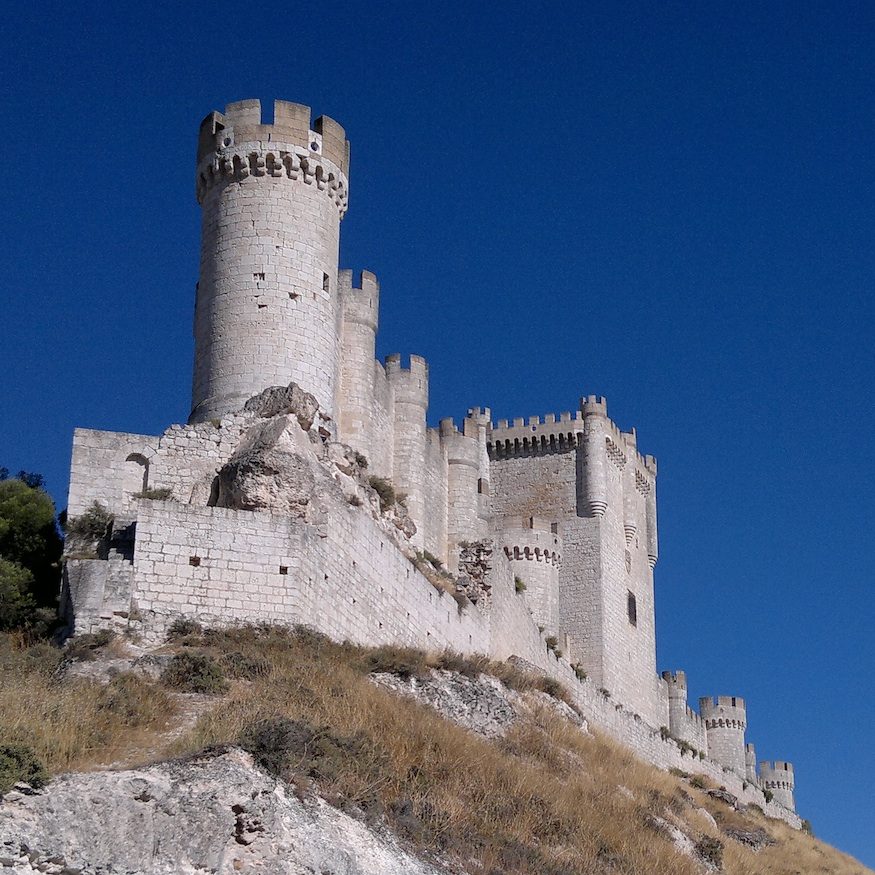
Photo: Fernandocenteno · CC BY-SA 3.0 es
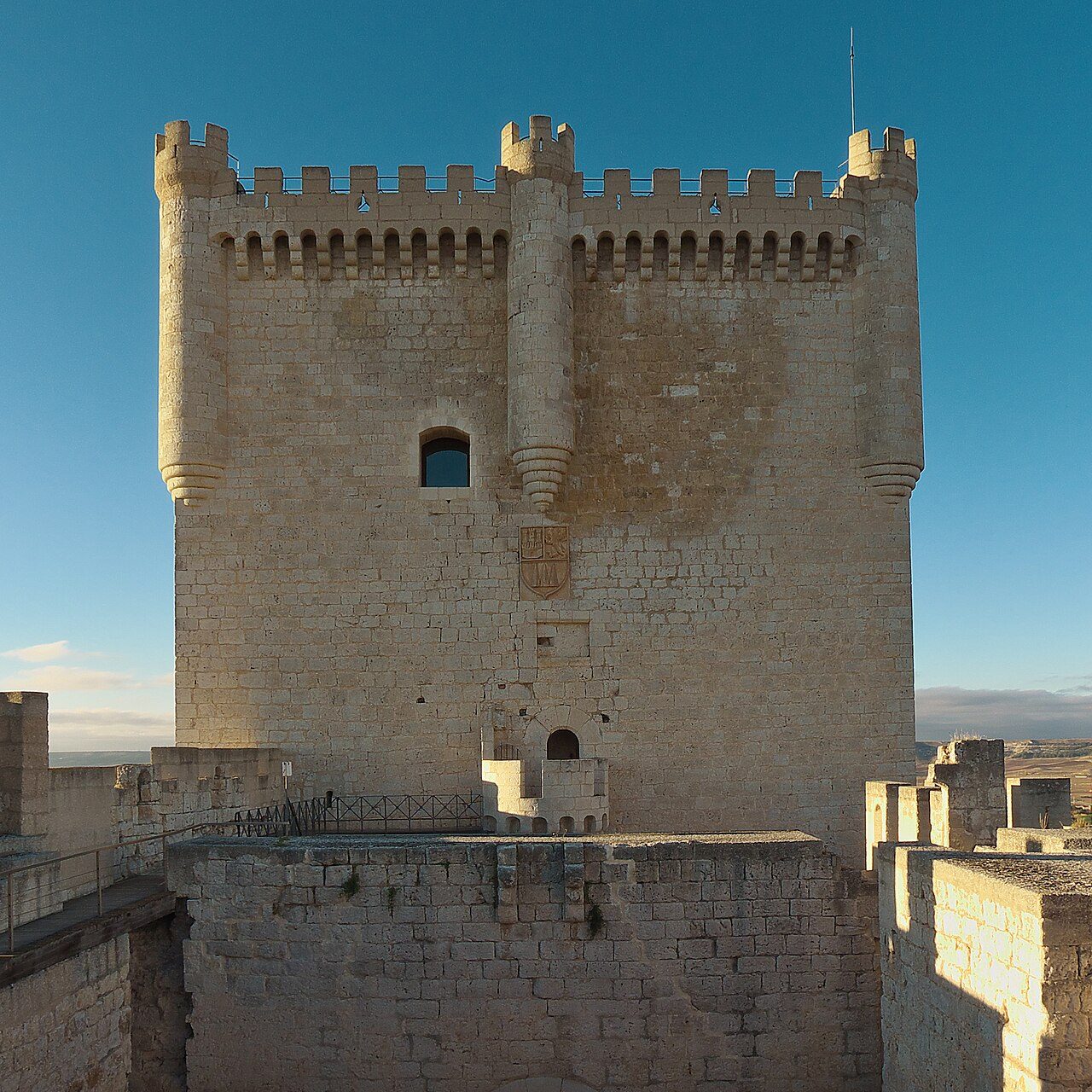
Photo: Jose Luis Filpo Cabana · CC BY 3.0
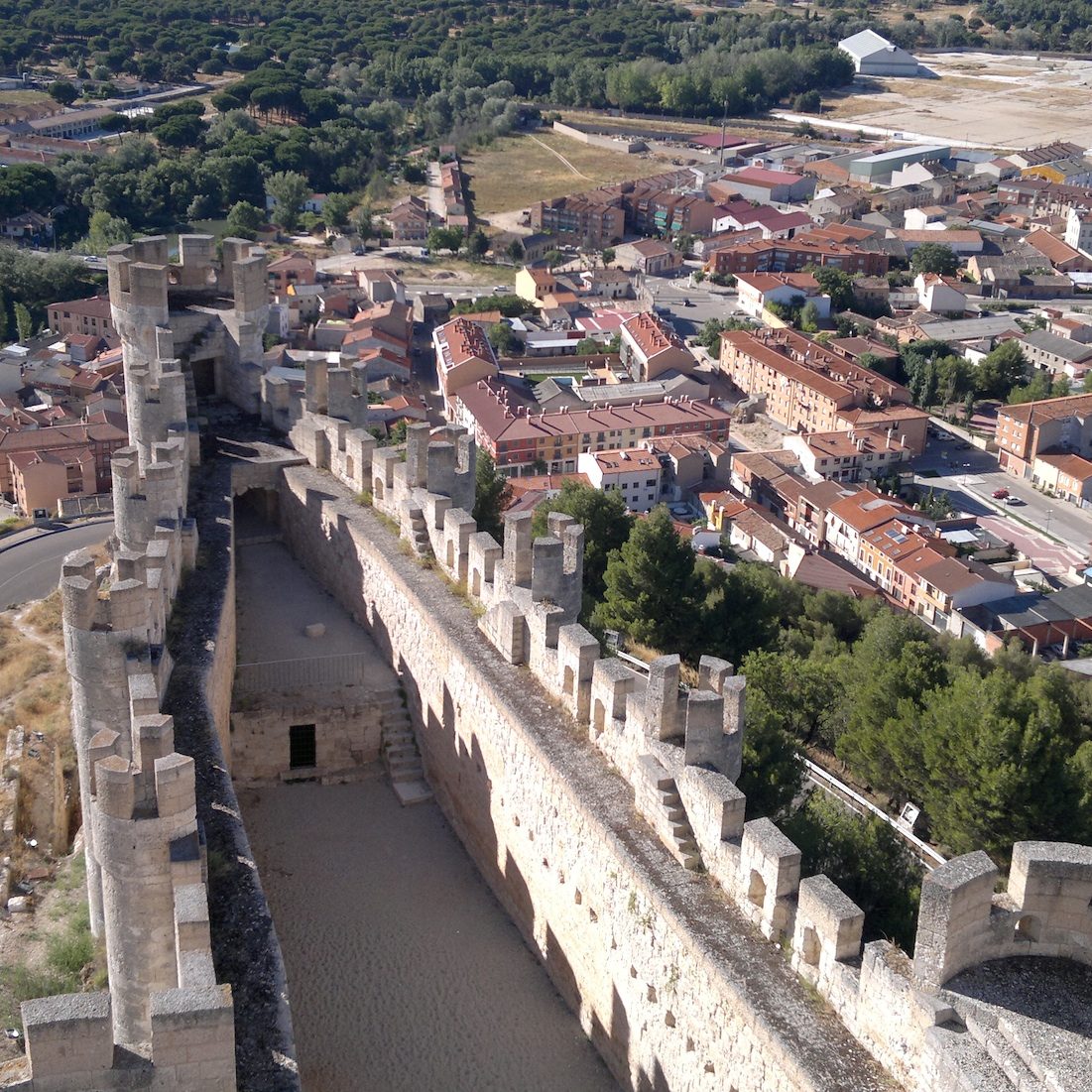
Photo: Fernandocenteno · CC BY-SA 3.0 es
- 943
First mention
Peñafiel Castle appears for the first time in a document from 943, right on the Duero frontier.
source: Sanz Platero, Santander. Estudios de Patrimonio 7 (2024) - 1013
Sancho García retakes the stronghold
After Almanzor's conquest, the Count of Castile recovers the site, and tradition credits him with the name Peña Fiel.
source: Turismo de Castilla y León - 1112
Siege of Alfonso the Battler
Queen Urraca's troops besiege Alfonso I inside the fortress.
source: Terranostrum - 1295–c. 1330
The castle of Don Juan Manuel
Don Juan Manuel rebuilds the «castiello mayor» on a hill he finds deserted and with the fortress in ruins, and in 1307 begins walling the town.
source: Sanz Platero, Santander. Estudios de Patrimonio 7 (2024) - 1337
Alfonso XI orders it torn down
After Don Juan Manuel's rebellion, the king orders the castle destroyed, and the work may have been interrupted.
source: Sanz Platero, Santander. Estudios de Patrimonio 7 (2024) - 1431–1451
Castilian civil war
John II decrees that the fortress be torn down, and it suffers serious damage during the Castilian civil war.
source: Sanz Platero, Santander. Estudios de Patrimonio 7 (2024) - 1456–c. 1470
Pedro Girón's great work
The Master of Calatrava obtains a license from Henry IV and rebuilds the castle using its remains, with 28 round towers and the present keep.
source: Sanz Platero, Santander. Estudios de Patrimonio 7 (2024) - 1583
Reinforcing the gate
Master builder Juan de Palacios consolidates the main gate for 27,000 maravedís, because rainwater was cracking one of the round towers.
source: Sanz Platero, Santander. Estudios de Patrimonio 7 (2024) - 1718–1722
The castle as a quarry
Cartloads of stone are taken from the first enclosure to rebuild the wall of the convent of Santa Clara, when the fortress is already in poor condition.
source: Sanz Platero, Santander. Estudios de Patrimonio 7 (2024) - 1917
National Monument
A royal order of June 1 declares the castle a National Monument.
source: Wikipedia, Castillo de Peñafiel - 1966–1973
The restoration
With the castle owned by the Town Council since 1957, restoration work is carried out.
source: Wikipedia, Castillo de Peñafiel - 1999
Provincial Wine Museum
The Town Council grants the castle to the Provincial Council for 50 years and the Provincial Wine Museum opens in the south courtyard.
source: Wikipedia, Castillo de Peñafiel
Using the 3D model we worked out how big this castle was and what it took to build it. Here is a sample:
- How many people worked, how much stone, lime and carts, year by year
- Work by work and how we calculate it
- The data to download (CSV)
Leave your email and you will see everything, for this castle and all the others. As a gift, the castle poster.
Already signed up? Sign in with your email🏰 Enter the castle in 3D⏳ See how it changed⚒ How they built it